


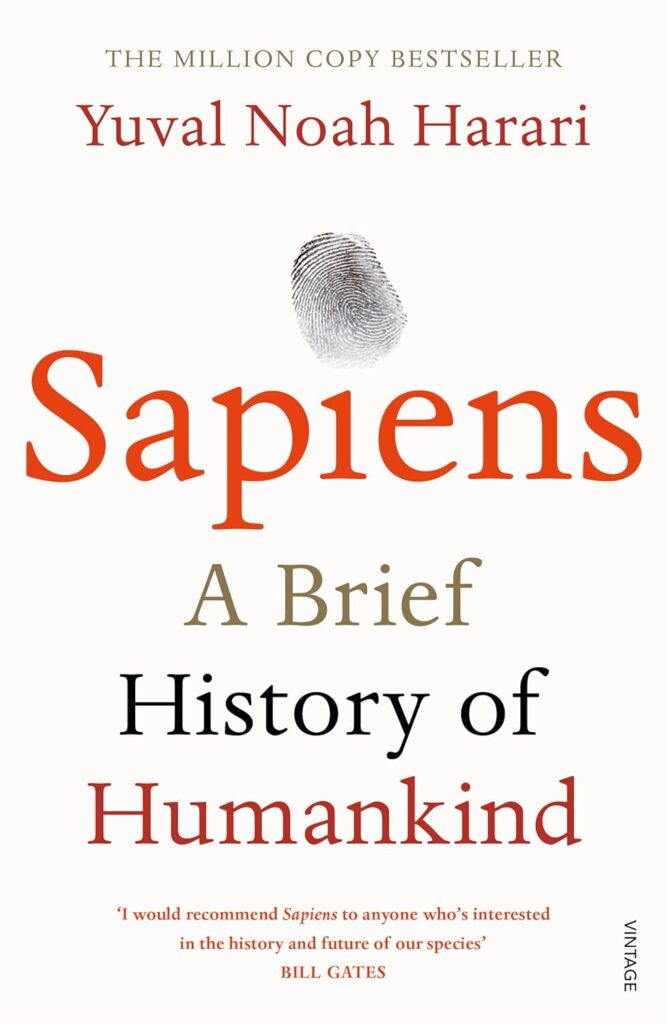
Read Brief Summary: https://nikitaagarwal.in/book/sapiens-a-brief-…ory-of-humankind/
Overview
Yuval Noah Harari’s Sapiens presents a sweeping narrative of human history, tracing our species’ journey from insignificant primates to the dominant force on Earth. The book argues that Homo sapiens succeeded not through individual superiority, but through our unique ability to cooperate in large numbers based on shared myths and beliefs.
Part I: The Cognitive Revolution (70,000 BCE)
The Great Leap Forward
The Cognitive Revolution refers to the period around 70,000 years ago when Homo sapiens developed new cognitive abilities that allowed them to think and communicate in unprecedented ways. This wasn’t about individual intelligence, but about the ability to create and believe in intersubjective realities – shared myths that exist only in our collective imagination.
Key Concept: Intersubjective Reality These are things that exist only because large numbers of people believe in them – money, gods, nations, corporations, and human rights. Unlike objective reality (rivers, trees) or subjective reality (personal pain), intersubjective realities depend on collective belief.
The Power of Fiction
Harari argues that our ability to create and believe in myths allowed unprecedented cooperation. While other animals can cooperate in small groups through personal relationships, humans can cooperate in groups of millions through shared stories. A Christian and a Muslim may never meet, but they can cooperate because they both believe in concepts like human rights, money, and nations.
Case Study: Peugeot Corporation Harari uses the French car company Peugeot as an example of intersubjective reality. Peugeot exists only in our shared imagination – it’s not the factories, workers, or cars themselves, but a legal fiction that allows massive cooperation. If all humans disappeared, the factories would remain, but “Peugeot” would vanish instantly.
The Agricultural Revolution’s Seeds
The chapter also introduces the concept of forager societies – small, mobile groups of hunter-gatherers who lived in bands of 25-150 people. These societies were remarkably egalitarian and knowledgeable about their environment, with each individual knowing thousands of species and their uses.
Part II: The Agricultural Revolution (10,000 BCE)
History’s Biggest Fraud
Harari controversially calls the Agricultural Revolution “history’s biggest fraud.” Around 10,000 years ago, humans began domesticating plants and animals, transitioning from nomadic foraging to settled farming. While this created civilization as we know it, Harari argues it made most humans worse off.
The Wheat Trap Using wheat as an example, Harari argues that we didn’t domesticate wheat – wheat domesticated us. Wheat convinced humans to settle down, work harder, and dedicate their lives to its care. In return, wheat spread across the globe, but individual humans became malnourished, overworked, and vulnerable to disease and famine.
Key Changes from Agriculture
- Population Growth: Agricultural societies could support much larger populations in smaller areas
- Social Stratification: Surplus food allowed for specialization and hierarchy
- Permanent Settlements: Cities and civilizations emerged
- Future Orientation: Farmers had to plan for seasons and years ahead
Case Study: Ancient Egypt The Egyptian civilization exemplifies agricultural society’s characteristics. The Nile’s predictable flooding created agricultural surplus, enabling a complex hierarchy with pharaohs, priests, scribes, and farmers. The pyramids represent the ultimate expression of agricultural society’s ability to organize massive human cooperation around shared myths of divine kingship.
The Luxury Trap
Harari introduces the concept of the luxury trap – the process by which innovations that initially seem to make life easier ultimately create new necessities and dependencies. Agriculture created a population boom that made returning to foraging impossible, trapping humanity in an increasingly complex system.
Part III: The Unification of Humankind
Three Universal Orders
Harari identifies three forces that gradually unified the human species:
1. Money: The Universal Language
Money represents the most successful intersubjective reality ever created. It allows complete strangers to cooperate by providing a universal medium of exchange. Money isn’t coins or bills, but the trust and belief system that makes people accept it.
Case Study: The Cowrie Shell For over 4,000 years, cowrie shells served as currency across Africa, Asia, and Oceania. These shells had no practical value but were accepted because everyone believed others would accept them. This demonstrates money’s power as pure intersubjective reality.
2. Empire: Political Unification
Empires are large political units that rule over diverse populations. Despite their often brutal methods, empires were crucial in unifying humanity by spreading ideas, technologies, and practices across vast territories.
Case Study: The Roman Empire Rome exemplifies how empires unify diverse populations. Roman citizenship eventually extended to all free inhabitants, creating a shared legal and cultural framework. Latin became the scholarly language for centuries, and Roman law influenced legal systems worldwide.
3. Religion: Spiritual Unification
Universal religions like Christianity, Islam, and Buddhism helped unify humanity by providing shared worldviews that transcended local loyalties. These religions offered universal truths and moral systems that could apply to all humans.
Case Study: Buddhism’s Spread Buddhism originated in India but spread across Asia, adapting to local cultures while maintaining core principles. It provided a universal framework for understanding suffering and achieving enlightenment, unifying diverse populations under shared spiritual goals.
The Merchant, the Conqueror, and the Prophet
Harari argues that these three forces – economic (money), political (empire), and religious (universal religions) – worked together to create increasingly larger unified human groups, ultimately leading toward a single global civilization.
Part IV: The Scientific Revolution (1500 CE)
The Discovery of Ignorance
The Scientific Revolution began around 1500 CE when Europeans made a crucial discovery: they realized how much they didn’t know. This admission of ignorance, combined with the belief that knowledge could be acquired through observation and experiment, launched the modern era.
Key Concept: The Feedback Loop of Science, Empire, and Capital Harari describes how science, imperial expansion, and capitalism became interlinked. Scientific discoveries enabled better navigation and weapons, facilitating imperial conquest. Imperial expansion provided resources and new knowledge, while capitalism funded scientific research and exploration.
The European Miracle
Why did the Scientific Revolution begin in Europe rather than China or the Islamic world? Harari argues it wasn’t European superiority but rather their unique combination of circumstances:
- Political fragmentation created competition between states
- Admission of ignorance rather than claims of complete knowledge
- Willingness to invest in long-term, uncertain projects
Case Study: The Conquest of the Americas The Spanish conquest of the Aztec and Inca empires exemplifies the power of the science-empire-capital feedback loop. Superior weapons, horses, and diseases gave Europeans advantages, but their real strength was their ability to adapt, learn, and systematically exploit new knowledge.
The Capitalist Creed
Capitalism emerged as the dominant economic system based on the belief that investment in production would generate profits that could be reinvested for more growth. This created the first economic system based on the assumption of perpetual growth.
Case Study: The Dutch East India Company The world’s first modern corporation, the Dutch East India Company (VOC), demonstrated capitalism’s power to mobilize resources for global ventures. It combined scientific navigation techniques, military technology, and financial innovation to dominate global trade.
The Human Condition
The Happiness Question
Throughout the book, Harari questions whether human progress has actually made people happier. He argues that despite tremendous technological and social advances, there’s little evidence that modern humans are happier than their forager ancestors.
The Hedonic Treadmill This psychological concept suggests that people adapt to improvements in their circumstances, returning to baseline happiness levels. Material progress may not translate to increased well-being.
Three Revolutions, One Species
Harari emphasizes that all three revolutions – Cognitive, Agricultural, and Scientific – changed human society but not human biology. We remain essentially the same species that evolved on the African savanna, now living in a world our ancestors couldn’t imagine.
Key Themes and Implications
The Power of Shared Myths
Perhaps the book’s most important insight is that human cooperation depends on shared beliefs in intersubjective realities. Nations, religions, corporations, and human rights exist only because we collectively believe in them, but this belief makes them incredibly powerful.
Progress vs. Happiness
Harari consistently questions whether human “progress” represents genuine improvement. While we’ve gained tremendous power over our environment, it’s unclear whether this has made us happier, more fulfilled, or better off than our ancestors.
The Acceleration of Change
Each revolution accelerated the pace of human change. The Agricultural Revolution took millennia to spread, but the Scientific Revolution’s effects unfold over centuries or decades. This acceleration continues today with biotechnology and artificial intelligence.
Looking Forward
The book concludes by noting that humans are now on the verge of transcending biological limitations through genetic engineering, artificial intelligence, and biotechnology. This potential bioengineering revolution could fundamentally alter what it means to be human.
Conclusion
Sapiens presents human history as a series of revolutions that increased our power but not necessarily our happiness. Our species succeeded through unique cognitive abilities that allowed large-scale cooperation based on shared myths. Understanding this history is crucial as we face decisions about humanity’s future in an age of unprecedented technological capability.
The book’s central message is that the forces shaping human history – our capacity for shared belief, our drive for cooperation, and our ability to create new realities through collective imagination – remain the same forces that will determine our future. As we stand on the brink of potentially becoming gods through technology, understanding how we became human becomes more important than ever.