



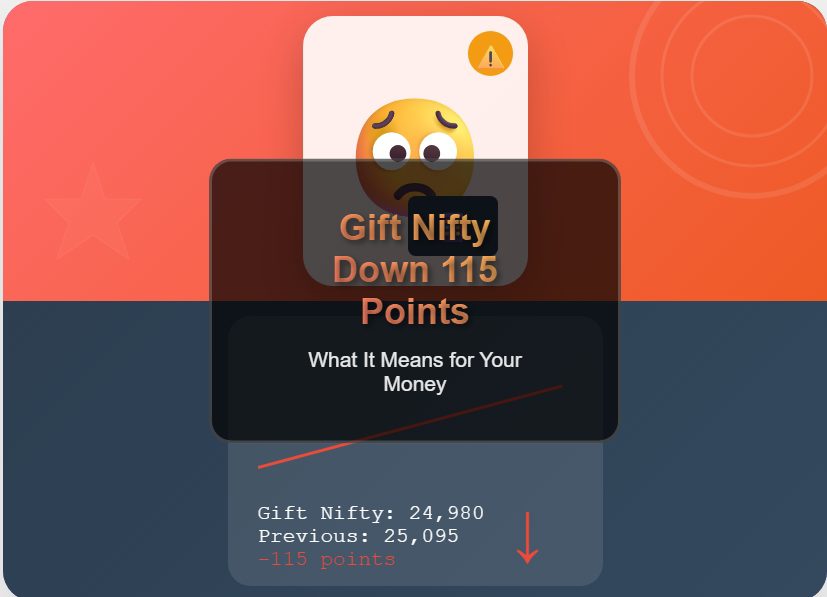
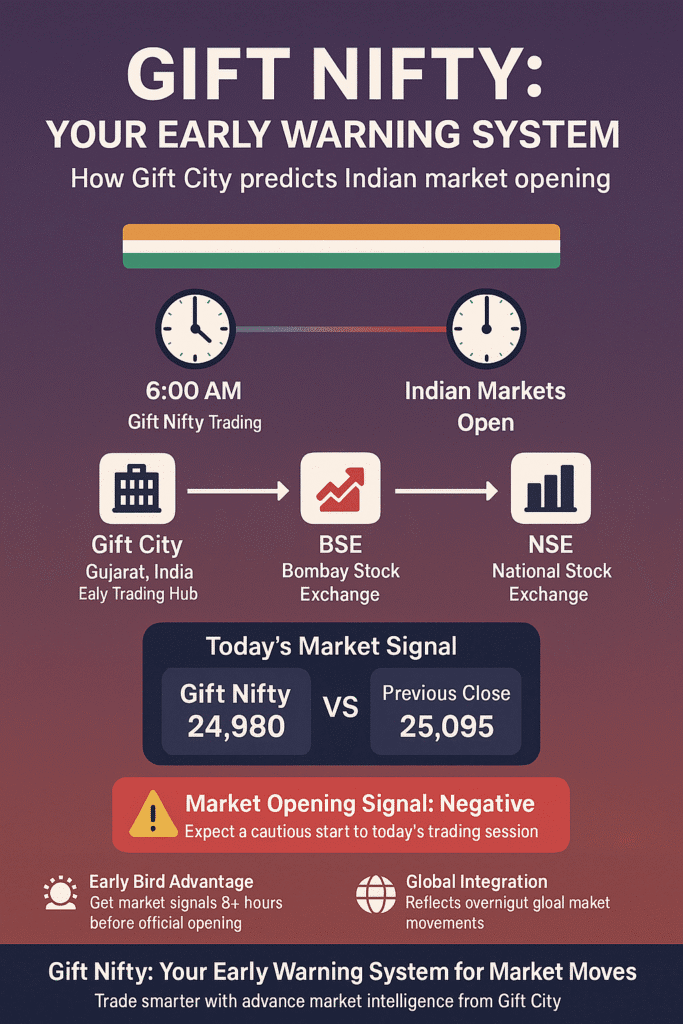
New Delhi, July 25, 2025 – If you’re among the millions of Indians who check their portfolio first thing in the morning, today’s opening might give you pause. The Gift Nifty, often called the crystal ball of Indian stock markets, was trading around 24,980 levels in early hours – a discount of nearly 115 points from the previous close. This suggests Indian markets may open on a negative note, but the story behind these numbers is more complex than it appears.
For retail investors, mutual fund holders, and anyone with money in the stock market, understanding these overnight developments isn’t just about numbers on a screen – it’s about protecting and growing your hard-earned savings in an increasingly interconnected global economy.

1. Gift Nifty Signals Caution: What This Means for Your Morning Portfolio Check
The Gift Nifty, trading at GIFT City in Gujarat, serves as an early indicator of how Indian markets might perform when they open at 9:15 AM. The Indian stock market saw a muted start on Monday, July 21, with Gift Nifty trading around 25,027 levels, though current levels suggest increased volatility.
Why this matters to you: If you’re planning to buy or sell stocks today, this early warning system helps you prepare for potential losses or gains. A 115-point discount means your portfolio might be in the red when markets open, but remember – Gift Nifty is just an indicator, not a guarantee.

2. India-UK Free Trade Agreement: A Game-Changer for Your Investments
Perhaps the most significant overnight development is the progress on the India-UK Free Trade Agreement (FTA). According to multiple reports dated July 22, 2025, India’s union cabinet has approved the FTA between the two nations, marking the end of three years of negotiations.
What’s in it for Indian investors and consumers:
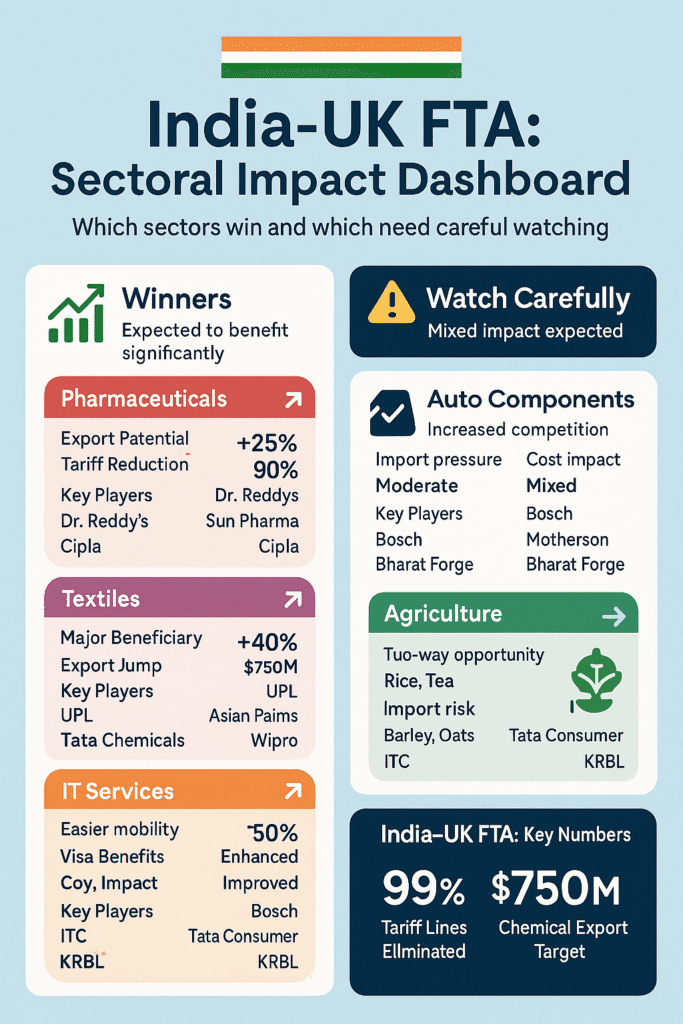
The FTA includes tariff elimination on 99% of Indian tariff lines, covering nearly 100% of trade value, and reduces tariffs on 90% of UK tariff lines. This isn’t just diplomatic jargon – it translates to real money in your pocket.
For instance, the FTA is anticipated to trigger a dramatic 30-40 per cent increase in India’s chemical exports to the UK, propelling figures to an estimated $650-750 million in 2025-26. If you hold shares in chemical companies like Asian Paints, UPL, or Tata Chemicals, this could be good news for your portfolio.
The consumer angle: Under the deal, it will cut levies on 90% of British products sold in the country. Within a decade, 85% of British products sold will become tariff-free in India. Some of the products affected include whisky, medical devices, potentially making these items cheaper for Indian consumers.
3. European Central Bank Policy: The Ripple Effect on Indian Markets
Global monetary policy decisions have a direct impact on emerging markets like India. The European Central Bank’s latest policy stance is being closely watched by Indian investors, as it affects foreign investment flows.
Why European policy matters to your Indian investments: When the ECB changes interest rates or monetary policy, it influences where global money flows. Lower European rates often mean more foreign investment in higher-yielding Indian markets, boosting your stock and mutual fund returns. Conversely, tighter European policy can lead to capital outflows from India.
4. Gold Prices: Your Hedge Against Uncertainty
Gold prices have always been a barometer of economic uncertainty, and overnight movements in precious metal prices are sending mixed signals to investors.
For the average Indian investor: If you hold gold ETFs, sovereign gold bonds, or physical gold, these price movements directly affect your wealth. Gold often moves inversely to stock markets, so when equity markets show weakness (as Gift Nifty suggests), gold can provide portfolio balance.
5. Global Cues and Their Local Impact
The Indian equity markets kicked off Wednesday’s session on a positive note, tracking firm cues from Asian peers after the announcement of a U.S.-Japan trade agreement. This demonstrates how interconnected global markets have become.
What this means for your investment strategy: In today’s world, your Indian portfolio is influenced by events in New York, London, Tokyo, and beyond. The overnight weakness in Gift Nifty could be reflecting concerns about global growth, geopolitical tensions, or central bank policies worldwide.
6. Sectoral Implications: Which Stocks to Watch
The India-UK FTA will have varying impacts across sectors:
Winners potentially include:
- Pharmaceutical companies (easier market access)
- Textile and apparel manufacturers
- Chemical and petrochemical companies
- IT services firms
Sectors to watch carefully:
- Automobile components (increased competition)
- Some agricultural products (market opening both ways)

7. Currency Movements and Import-Export Dynamics
Trade agreements and global policy changes affect the rupee’s strength, which in turn impacts everything from your foreign vacation costs to the price of crude oil India imports.
Personal finance impact: A stronger rupee (possible with increased trade) makes imports cheaper but can hurt export-oriented companies in your portfolio. A weaker rupee does the opposite.
8. Long-term vs. Short-term Perspective
While Gift Nifty suggests a weak opening, successful investing requires looking beyond daily fluctuations.
For long-term investors: The India-UK FTA represents a structural positive for the Indian economy. This deal slashes red tape and cuts tariffs, making it quicker, cheaper and easier to trade from the first day the deal comes into force. This could boost economic growth and corporate earnings over the coming years.
For short-term traders: Today’s weak opening might present buying opportunities in quality stocks, but remember that short-term trading requires careful risk management.
What Should You Do?
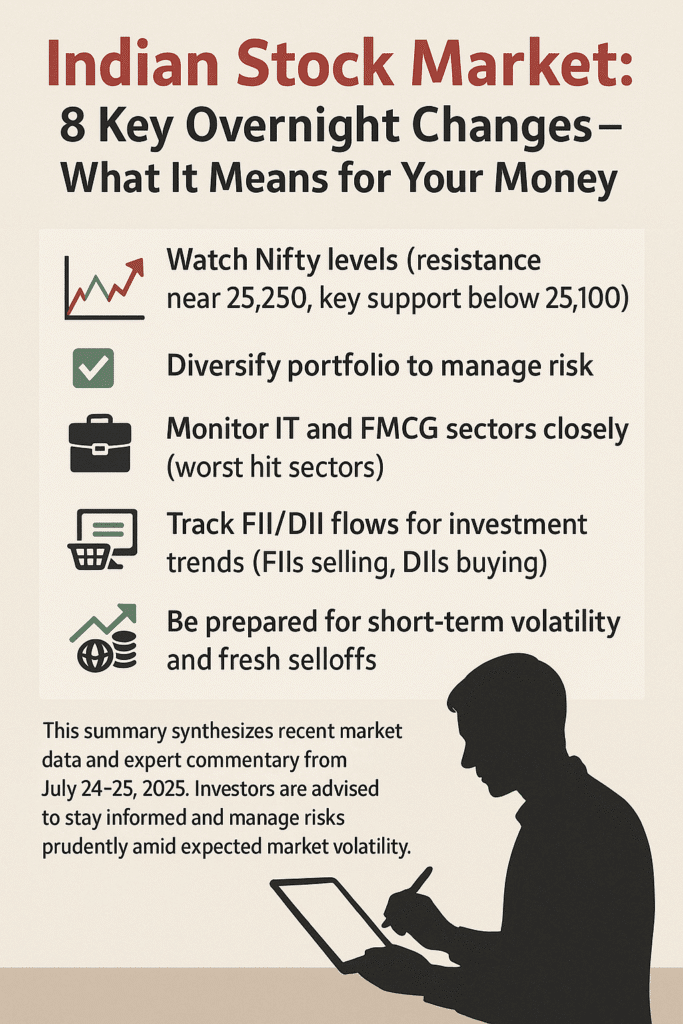
- Don’t panic about the weak Gift Nifty reading – it’s one indicator among many
- Review your portfolio allocation – ensure you’re not over-exposed to any single sector
- Consider the FTA’s long-term benefits – this could be a structural positive for Indian exporters
- Stay informed about global developments – they increasingly impact Indian markets
- Maintain your investment discipline – avoid making emotional decisions based on daily fluctuations
The Bottom Line
Today’s market opening might be subdued, but the underlying story is one of India’s growing integration with the global economy. The India-UK FTA, despite short-term market volatility, represents a significant step toward making Indian businesses more competitive globally and potentially making certain goods cheaper for Indian consumers.
For the average investor, these developments underscore the importance of diversification, staying informed about global trends, and maintaining a long-term perspective. While Gift Nifty suggests a cautious start to the day, remember that successful investing is about riding out short-term volatility while benefiting from long-term economic growth.
As you check your portfolio today, keep in mind that you’re not just investing in individual companies – you’re investing in India’s economic future, which increasingly depends on its ability to navigate and benefit from global trade relationships and policy changes.
The author is not a registered investment advisor. This article is for informational purposes only and should not be considered personalized investment advice. Please consult with a qualified financial advisor before making investment decisions.